
Category

Tips and Hints

12/12/2025
, , ,

The Perfect Christmas Gift

Finding the ideal Christmas gift can be a challenge — especially when you want something thoughtful, practical, beautifully made, and guaranteed to be appreciated long after the festive season ends. At Knives From Japan, we believe the best gifts are those crafted with purpose, precision, and tradition. Japanese knives and tools embody all of this: exceptional craftsmanship, timeless design, and a level of quality that transforms everyday cooking into a joy. Whether you’re buying for a home cook, a professional chef, or someone who simply loves beautiful, functional gifts, our... Read More


01/08/2025
, , , ,

Why Invest in a Handmade Japanese Knife?

A handmade Japanese knife is more than a tool; it’s an extension of culinary artistry. Blending centuries of tradition, unparalleled craftsmanship, and advanced metallurgy, these knives offer precision and longevity unmatched by mass-produced alternatives. At Knives from Japan, we pride ourselves on sourcing our blades directly from the most specialist handmade hubs within Japan, such as the renowned Sakai region, ensuring you receive not just a knife, but a piece of authentic, master-crafted heritage. This guide explores their rich history, meticulous crafting, superior materials, performance benefits, and essential care, ensuring... Read More

16/03/2023
, ,

What is Knife Thinning?

Knife thinning is exactly what you would think, it is the process of thinning the profile of your knife. Now how is this different to sharpening your knife? When you sharpen your knives you focus on the cutting edge of the blade but a sharp edge is just the first step to a high performing blade, the initial cut comes from the edge however we need to take into consideration the thickness of the material behind that edge. The thicker the knife, the more resistance it will encounter in the... Read More

26/05/2020

What is Carbon Steel?

Carbon steel is steel with minimal alloying. Typically ‘stainless steel’ is mixed with nickel or chromium to make it stainless and resistant to rust, but these alloys are only mixed in with the iron, there is no chemical bonding between the different elements. These elements will clog up whetstones during sharpening. Carbon steel is essentially steel without these elements mixed in. Carbon steel knives that are heat treated effectively are capable of the highest levels of sharpness whilst being generally easier to sharpen and are beloved by chefs in heavy... Read More

19/05/2020

Powdered Steel

Powdered steels are some of the latest innovations in steel making to be used in kitchen knife manufacturing.  Powdered steel is made by sintering different metals in the alloy into a very fine grain where the different elements are bonded into a consistent microstructure. It is a very precise method done in a laboratory rather than a steel mill. The resulting alloys have the best edge retention and can be easy to re-sharpen. Of course these most advanced steels, carry a price premium. Powdered steels considerably close the gap between... Read More

08/05/2020

Flutes in the Blade

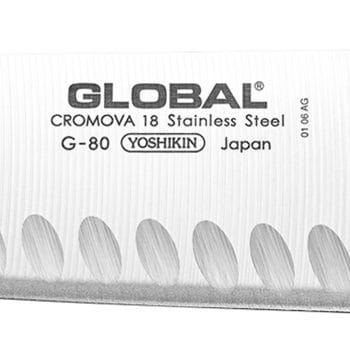
We get asked quite often, what the flutes in the blades are for. Really they are designed to stop food sticking to the blades. Do they work? So, so. You will find flutes mainly on foods designed for chopping vegetables, which can be quite starchy. Global 18cm Fluted Santoku Knife Is there a downside? Well in short yes. Grooves on new knives are initially not a problem, but if the knives are used in heavy use settings, where the knives need to be sharpened often, once the metal is ground... Read More

24/04/2020

Single Bevel vs Double Bevel

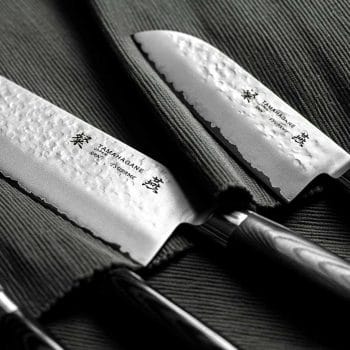
A knife bevel refers to the surface of the blade that has been sharpened to a point. Western knives all have double bevels, referring to equal grinds on both sides of the blade. This type of blade is now the most commonly used for cooking at home. The most popular double bevel knives we have are: Kasumi Hammered 18cm Santoku Knife Tamahagane San 17.5cm Santoku Knife Tojiro Senkou DP (Flash) 18cm Santoku Knife Traditional Japanese knives use a single bevel, where the angle of the knife is formed on one... Read More

10/04/2020

A Guide to Knife Grinds

Different brands of knives use different kinds of grind. Flat or V Grinds Very common on Japanese knives, simply both sides of the knife extend down towards the edge of the blade at a common angle. Flat grinds can produce very sharp edges, and are wonderful at making very thin slices. More common than true flat grinds are double bevel grinds, which have an initial shallower grind before being finished with a secondary bevel. As the edge finishes at a microscopic point, flat edges will dull more quickly than other... Read More