
Why Invest in a Handmade Japanese Knife?
A handmade Japanese knife is more than a tool; it’s an extension of culinary artistry. Blending centuries of tradition, unparalleled craftsmanship, and advanced metallurgy, these knives offer precision and longevity unmatched by mass-produced alternatives. At Knives from Japan, we pride ourselves on sourcing our blades directly from the most specialist handmade hubs within Japan, such as the renowned Sakai region, ensuring you receive not just a knife, but a piece of authentic, master-crafted heritage. This guide explores their rich history, meticulous crafting, superior materials, performance benefits, and essential care, ensuring a deeper appreciation for these culinary masterpieces.
Find all handmade knives here.
1. A Legacy Forged in History: From Samurai Swords to Kitchen Essentials
The legacy of Japanese knife-making spans over a millennium, originating from the ancient craft of samurai sword-making. Techniques refined for creating the world’s finest swords were adapted for kitchen cutlery, ensuring unparalleled sharpness and durability. In Japan, knives are deeply respected; professional chefs view them as an extension of their body, meticulously sharpening them daily.
The *hocho-zuka mound, where old knives are ceremonially buried, and the mottainai philosophy (maintaining objects with care for long use) underscore this reverence, promoting multi-generational use. Over time, specialised knives like Deba (fish), Yanagiba (sashimi), and Nakiri (vegetable) emerged, culminating in the global acclaim for “Japanese knives“. This cultural depth directly translates into the meticulous craftsmanship and inherent longevity of these tools.

*A hocho-zuka is a “kitchen-knife mound” in Japan, a dedicated burial site for old or broken knives. This tradition is a way to show respect and gratitude for a knife’s years of service, based on the belief that a well-used tool can acquire a spirit. It’s an important practice that highlights the deep cultural reverence Japanese chefs have for their tools.
2. The Art of Craftsmanship: Precision in Every Stroke
Handmade Japanese knives are a testament to traditional blacksmithing. Artisans repeatedly heat, hammer, and quench steel to achieve desired shape and strength. A core technique is lamination, where hard cutting steel (hagane) is forge-welded between softer layers (jigane) (e.g., *San-Mai or *Warikomi methods). This creates a razor-sharp edge with a durable, crack-resistant spine. Blades undergo quenching (rapid cooling for hardness) and tempering (controlled heating to reduce brittleness). Sharpening is a meticulous, multi-stage hand process using traditional Japanese whetstones, achieving an unbelievably fine edge.
*San-mai translates to “three layers” and, in this construction, a softer steel is forge-welded onto either side of hard steel core, giving the blade a structural integrity without sacrificing its ability to hold an edge.
*Warikomi – The hard core of a knife is sandwiched between two layers of softer steel, reaching only up to a half of the blade’s width.
Distinctive Damascus steel patterns, formed by folding layers, also reduce cutting drag and aid food release. Handles, often from magnolia wood and buffalo horn, are ergonomically shaped for comfort and control. The creation of a single knife is labour-intensive, requiring multiple skilled craftsmen and weeks to complete, reflecting decades of honed expertise and a profound dedication to the art.
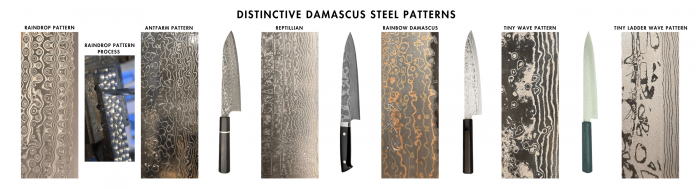
There are several types of Damascus patterns, each with their own distinct look and characteristics. Let’s look at just five common ones.
- Twist Pattern: This pattern is achieved by twisting and forging two or more bars of steel together. The result is a pattern that resembles a twisted rope.
- Random Pattern: Also known as the “wild” pattern, this style features a random and unpredictable pattern that is created by layering and folding the steel as it naturally shapes itself.
- Wavy Pattern: As the name suggests, this pattern features a wavy design that is created by manipulating the layers of steel by bending during the forging process.
- Raindrop Pattern: This pattern is characterised by its distinct raindrop-shaped designs, which are achieved by drilling the plates or by hammering the steel billet with a pointy hammer in a dotted pattern.
- Ladder Pattern: This pattern features a series of straight lines that are arranged in a ladder-like formation. The lines are created by stacking and folding the steel in a specific way creating the cross-sections.
These are just a few examples of the many types of Damascus patterns available. Each pattern offers a unique look and style that can add an extra level of beauty and artistry to a knife or other steel product.
3. Superior Materials: The Heart of Unrivalled Performance
Handmade Japanese knives are defined by their use of high-quality, high-carbon steel, which holds a sharper edge than mass-produced alternatives.
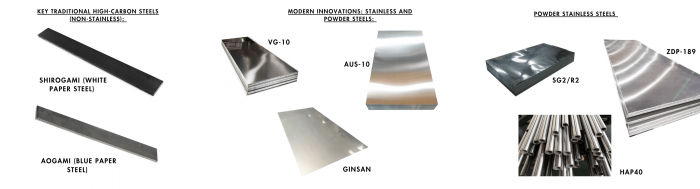
Key Traditional High-Carbon Steels (Non-Stainless):
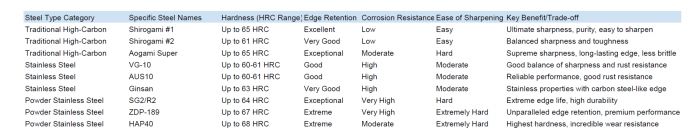
Japanese blacksmiths favour Shirogami (White Paper Steel) and Aogami (Blue Paper Steel) for their ease of forging, edge retention, and sharpness. Aogami, especially Aogami Super, includes chromium and tungsten for enhanced edge retention and rust resistance, making it a top choice for sharpness and durability.
Modern Innovations: Stainless and Powder Steels: Modern makers also use advanced alloys. Stainless Steels (e.g., VG-10, AUS10, Ginsan) contain over 12% chromium for rust resistance, offering easier maintenance.
Powder Stainless Steels (e.g., ZDP-189, SG2/R2, HAP40) represent the peak of metallurgy, achieving extreme hardness (up to 67-68 HRC) and exceptional, long-lasting edge retention, though they are harder to forge and sharpen.
This precise material science, from carbon content to alloy additions, directly dictates performance. This precise engineering ensures that while the steel is hard enough for exceptional edge retention, it remains at an optimal ‘Goldilocks’ hardness – not so hard as to be impossible to sharpen, allowing for effective maintenance with whetstones. Different steels cater to diverse needs, from ultimate sharpness to ease of maintenance, justifying the investment in these meticulously engineered tools.
4. Unleashing Culinary Potential: Performance Advantages
Handmade Japanese knives offer superior cutting performance, thanks to harder steel and acute edge angles that create incredibly sharp, long-lasting edges. Their thin profile allows effortless gliding through ingredients, reducing hand fatigue and enhancing efficiency.
Learn how to sharpen your knife using a whetstone in our master class!
Key Performance Advantages:
- Exceptional Edge Retention: Superior materials like Aogami-Super and expert heat treatment ensure prolonged sharpness and durability.
- Lightweight & Manoeuvrable: Lighter, narrower designs compared to Western knives provide comfort, control, and reduced fatigue during extended use.
- Enhanced Precision: Thinner blades enable incredibly precise cuts for delicate tasks, improving food presentation and preserving cellular structure. This precision is further amplified by the unique blade geometry; many traditional Japanese knives feature a single-bevelled edge sharpened to an acute 10–15-degree angle, significantly sharper than the wider angles (often 15-20 degrees per side for double-bevel) found on most Western knives, allowing for unparalleled cutting performance and delicate work. This acute angle is a key differentiator, making Japanese knives uniquely suited for fine, precise cuts that are difficult to achieve with their Western counterparts.
- Ergonomic Design: Handles crafted from natural materials like magnolia wood are shaped for comfort and enhanced grip, vital for control.
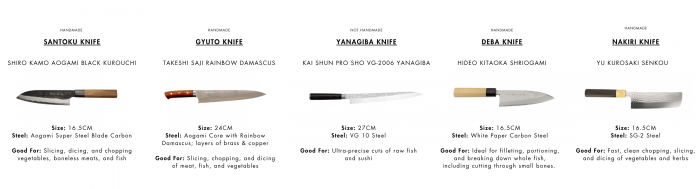
- Versatility & Specialisation: The wide variety, from multi-purpose Santoku and Gyuto to specialised Yanagiba (sashimi) and Deba (fish), ensures a perfect knife for every culinary task.
- Long-Term Investment: Despite a higher initial cost, their superior quality, durability, and longevity make them a worthwhile investment, outperforming and outlasting many mass-produced alternatives.
5. Addressing Common Misconceptions and Essential Care
While renowned, handmade Japanese knives face misconceptions. They aren’t universally “best”; quality varies, and talented craftsmen exist globally. High-carbon blades require more care and can be brittle, making them less suitable for rough handling. Rust indicates poor maintenance, not cheapness, especially for non-stainless steels.
Essential Care for Longevity: Proper care is crucial, especially for carbon steel knives.
- Cutting Surface: Always use a wooden end grain board; avoid hard surfaces like glass or marble to prevent blade damage.
- Washing: Hand wash immediately after each use with mild detergent; never use a dishwasher.
- Drying & Storage: Thoroughly dry and store in a cool, dry place.
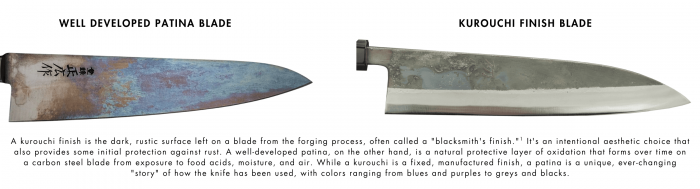
- Patina vs. Rust: Black spots or a grey patina will naturally develop on the blade over time; this is a protective coating that helps prevent rust. For many enthusiasts, this developing patina is not a flaw but a beautiful sign of character and a testament to the knife’s journey and use. This is distinct from a Kurouchi finish, which is a pre-existing dark, rustic finish left on the blade from the forging process, often seen on traditional carbon steel knives, and is also highly valued for its aesthetic appeal and protective qualities. However, if the rust appears reddish-brown, it indicates actual rust and should be promptly removed using steel wool, ideally with knife maintenance oil.
- Sharpening: Regular sharpening is key: aim for at least once a month using whetstones (coarse, medium, finishing grits). This brief, consistent effort—around 20 minutes—will effectively maintain your knife’s edge.
- Long-term Storage: Apply camellia or olive oil, wrap in newspaper, and store in a cool, dry place.
- Cautions: Avoid extreme heat, microwaves, harsh detergents, and prolonged sunlight.
Handmade Japanese knives are more than tools; they embody a rich cultural legacy, meticulous craftsmanship, and advanced material science, offering unparalleled sharpness, durability, and an enhanced culinary experience. Their value lies in this blend of tradition and performance.
✨ Coming Next…
Would you like to dive deeper into the world of the blacksmiths we work with? In our next blog, we’ll take you on a journey to Japan, where you’ll discover the rich backgrounds, stories, and incredible creations of these master artisans. Stay tuned—you won’t want to miss it!
Comments are closed here.