Author

Zia Rahim

15/07/2021

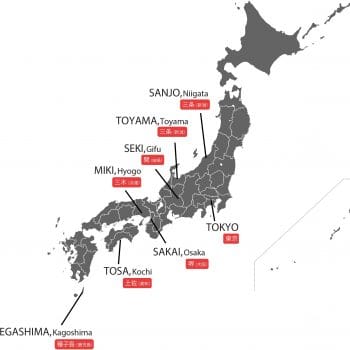
Knife Making Areas of Japan

Japan has a long tradition of knife manufacturing and it is a tradition that is not just limited to one area, like in the UK (Sheffield), Germany (Solingen) or France (Thiers). Japanese knife manufacturing is spread out over the whole country, but generally there are important differences in the types of product coming out of each area. Tsubame-Sanjo Located on the West coast of Japan around the prefecture of Niigata are located Japan’s most famous knife factories. The city of Tsubame has had a large metal working industry since the... Read More

15/07/2021

Why Japanese Knives are the best Knives!

Why Japanese Knives are the Best Knives! Japanese Knives have a reputation for being much sharper than their European counterparts, but why is this and why is a sharper knife better? Japanese Knives are generally constructed using much harder steels than European knives. Using hard steel allows Japanese knife makers to make quite thin blades that are able to hold their edges a lot longer than European knives and be sharpened to a much finer point. Japanese knife manufacturing techniques have evolved from traditional sword making techniques in a similar... Read More

15/07/2021

Why is a Japanese Knife more expensive?

High End Materials High end materials, like powdered steels, do not come cheap. These steels which are specially made for knives are made in small quantities by very advanced mills. Many of these high-end steels require very specialist knowledge on how to forge and strengthen the steel. Few manufacturers know how to work with steels like this, or simply do not bother as the high price means that knives cannot be made on a mass scale. Many Chinese factories have access to VG-10 or copies of VG-10. The steel used... Read More

15/07/2021

Top 10 Best Japanese Chef’s Knives

Top 10 Best Japanese Chef’s Knives Global G-2 Best Looking Exquisite looks and modern design, despite being released over 35 years ago. We still think that Global makes the best all round Japanese knife. Its convex edge means it will stay sharp out the box for a long time. Unlike some of the newer brands, it is not too hard, but will hold a good edge and look great in a set in the kitchen. Tamahagane San SN-1105 For the connoisseur Simply gorgeous to look at and hold, Tamahagane’s 3... Read More

Best Japanese Knife Brands

The Top Japanese Knife Brands The Japanese have an unrivalled ability to make the best chef’s knives in the world. Japanese forging techniques are renowned all over the world and the Japanese mentality of perfection, making sure only the best materials and manufacturing techniques are used, ensures quality. Global Probably the most famous of all the big Japanese knife manufactures. Global have been making their signature range since 1985 when the knives were launched on the worldwide market and were truly revolutionary in design and performance. Global make over 150... Read More

19/05/2020

Powdered Steel

Powdered steels are some of the latest innovations in steel making to be used in kitchen knife manufacturing.  Powdered steel is made by sintering different metals in the alloy into a very fine grain where the different elements are bonded into a consistent microstructure. It is a very precise method done in a laboratory rather than a steel mill. The resulting alloys have the best edge retention and can be easy to re-sharpen. Of course these most advanced steels, carry a price premium. Powdered steels considerably close the gap between... Read More

24/04/2020

Single Bevel vs Double Bevel

A knife bevel refers to the surface of the blade that has been sharpened to a point. Western knives all have double bevels, referring to equal grinds on both sides of the blade. This type of blade is now the most commonly used for cooking at home. The most popular double bevel knives we have are: Kasumi Hammered 18cm Santoku Knife Tamahagane San 17.5cm Santoku Knife Tojiro Senkou DP (Flash) 18cm Santoku Knife Traditional Japanese knives use a single bevel, where the angle of the knife is formed on one... Read More

05/03/2019

Japanese Productive Regions for Kitchen Knives

Japan is well-known to be an advanced country in technology, including in the production of knives. Since the feudal era, Japan has developed “Katana”, a traditionally made Japanese sword that was used by samurai. Sword itself is known as a first industrial art object that possessed a brand name. Sword making began in Japan after the manufacturing methods were imported to Japan through Mainland China and the Korean Peninsula. In Momoyama era, at the beginning swords were mainly manufactured at 5 regions in Japan (Soshu [Kanagawa], Bizen [Okayama], Yamato, [Nara],... Read More

04/02/2019

Western vs Japanese Knives

Blade Styles 1) Western VS Japanese Style Knives Almost every manufactures makes both Western and Japanese-style knives. What’s more, Japanese knives can also be made with either Western-style blades or handles, or even both. In other words, most companies offer a number of knives in Japanese and Western-style. Also, pretty much all European and American manufacturers produce various knives influenced by the Japanese-style. But, why are Japanese-style knives so special? Namely, the edge of their blade is more long-lasting and doesn’t need frequent sharpening thanks to the harder steel it... Read More

04/12/2018

Which whetstone should you choose

Widely recognised and known for their great qualities, Japanese whetstones, also referred to as waterstones, can be both natural and synthetic. These fine-grained stones can be used not only for sharpening Japanese blades, but also any other cutting tools So, there’s no need of buying a new set of knives. All you need is to purchase a whetstone. So, what’s so amazing about whetstones? The thing is that while sharpening knives with a whetstone, the surface particles are washed away pretty fast. This allows new particles, which are sharp, to... Read More