

Takeshi Saji
Born in 1948, Takeshi Saji is a legendary and highly respected third-generation Japanese master blacksmith. Based in Takefu City, in the historic knife-making region of Echizen, Mr Saji was born into a family of blacksmiths and began his apprenticeship at just 14 years old. He first trained under his uncle and later honed his skills under his father.
In 1992, he was officially recognised as a “Traditional Master Craftsman” by the Japanese government, an award given to highly skilled traditional artisans. He also helped establish Takefu Knife Village to help preserve traditional Japanese knife-making and pass these skills on to younger artisans.
Mr Saji takes pride in trying new ideas and enjoys a challenge, designing unique blades and using unusual handle materials that are rarely seen in traditional Japanese knives. His work combines traditional Japanese forging techniques with Western-inspired designs, creating knives that are both practical and highly collectible.
Today, Takeshi Saji knives are known for their unique designs, handmade quality and attention to detail, making them highly sought after by chefs, collectors and Japanese knife enthusiasts around the world.
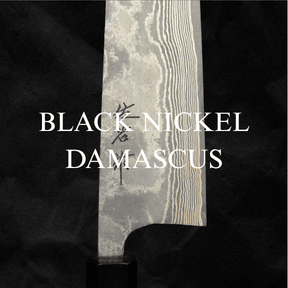
Black Nickel Damascus
The Takeshi Saji VG-10 Black Nickel Damascus range is known for its distinctive, black-finished blade. The multi-layered Nickel Damascus cladding is treated using an acid-etching process, which darkens the steel and creates a deep black finish. This brings out the bright nickel lines and flowing Damascus pattern across the blade, creating a strong contrast across the blade.
At the centre of the blade is a premium VG-10 stainless steel core, known for its excellent edge retention and rust resistance. With a Rockwell hardness of 61–62 HRC, the blade is hard enough to hold a sharp, double-bevel edge while still being practical for everyday kitchen use. The knives are finished with premium Ebony wood handles and genuine Buffalo Horn ferrules, complementing the dark Damascus blades.
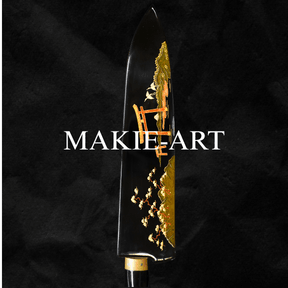
Makie-Art
The Takeshi Saji Makie-Art Mirrored Damascus range is a luxury collection in the Japanese knife world. It combines traditional Japanese knife making with the art of Maki-e. Each knife features a hand-forged Damascus blade made by Takeshi Saji, with the handle and matching wooden sheath, known as a Saya, decorated by Japanese Maki-e lacquer artist Kouichiro Tsukada.
The handles and Sayas are finished using traditional Urushi lacquer, with detailed Maki-e artwork applied by hand using lacquer and gold or silver powder. The designs feature traditional Japanese scenes and motifs, including Mount Fuji, sailboats and the Shinto gods of wind and thunder, Fujin and Raijin.
The blade has a highly polished diamond-mirror finish, which reflects light across the subtle Damascus pattern and gives the blade its distinctive appearance. Hardened to around 63 HRC, this provides excellent edge retention, hardness and rust resistance while maintaining a very sharp cutting edge.
Each knife combines the traditional skills of a Japanese master blacksmith and a Maki-e artist, making the Takeshi Saji Makie-Art Mirrored Damascus range both a high-performance Japanese kitchen knife and a highly collectible piece of Japanese craftsmanship.
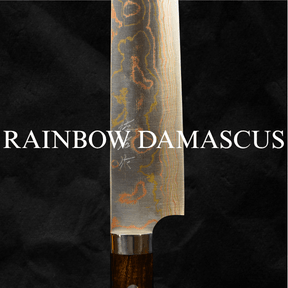
Rainbow Damascus
The Rainbow Damascus range combines traditional Japanese knife making with a unique and colourful Damascus finish. Each blade is hand-forged and the layers of brass, copper and stainless steel are folded over the steel core.
During the etching process, the different metals react differently, revealing multi-coloured waves of gold, rose-gold and silver across the blade. This gives each knife its own unique pattern.
At the centre of the blade is either Aogami Super (Blue Paper Steel) or VG-10 stainless steel, depending on the knife. Aogami Super is highly regarded for its ability to take an extremely sharp edge, while VG-10 offers excellent edge retention and rust resistance. The blades can reach around 63 HRC, providing a hard, sharp edge with excellent edge retention.
Takeshi Saji pairs these colourful Damascus blades with premium Western-style handles, creating a contrast between the vibrant blade and the darker handle. Each knife is hand-forged in limited quantities, making the Rainbow Damascus range highly sought after by Japanese knife collectors and enthusiasts.
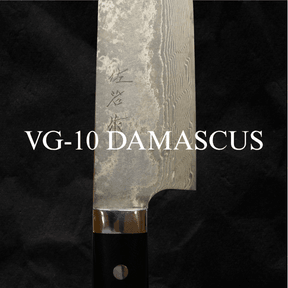
VG-10 Damascus
The VG-10 Damascus range combines traditional Japanese knife making with a practical design made for everyday use. It features a classic, high-contrast monochrome Damascus pattern, giving the blades a flowing, water-like appearance.
Both the VG-10 core and the outer Damascus layers are made from stainless steel, making these knives highly resistant to rust and discolouration. This makes the range a practical choice for professional chefs and home cooks who want the distinctive look of a Takeshi Saji Damascus knife without the extra maintenance of carbon steel.
At the centre of each blade is a high-carbon VG-10 stainless steel core. With a hardness of 61–62 HRC, it provides incredible sharpness, excellent edge retention and rust resistance. The blades are paired with Western-style handles, giving the knives a comfortable and familiar feel in the hand.
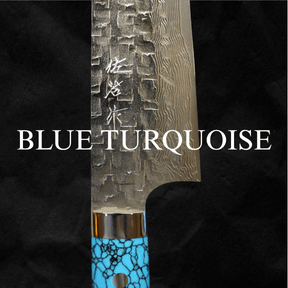
Blue Turquoise
The Blue Turquoise VG-10 Damascus Hammered range combines traditional Japanese knife making with a striking hammered Damascus blade and a vibrant blue handle. The hammered finish gives each blade a unique appearance.
The blade features a traditional Tsuchime hammered finish, creating small gaps along the top which helps to reduce food sticking to the blade. Below the hammered gaps, the steel transitions into a high-contrast monochrome Damascus pattern, showcasing the many layered folds of the forge.
The blade has a high-carbon VG-10 stainless steel core, with a hardness of 61–62 HRC, it provides incredible sharpness, excellent edge retention and good rust resistance, making it well suited to both professional kitchens and everyday use.
The knives are finished with a blue Western-style handles made from Turquoise Corian. The handle is moisture-resistant which is well suited to busy kitchen environments.