

Born in 1956, Tsukasa Hinoura is a third-generation Japanese master blacksmith based in Sanjo City, Niigata Prefecture. The Hinoura family has been making knives since 1905, with Tsukasa continuing the family tradition at Hinoura Hamono.
Tsukasa initially had no plans to become a blacksmith, but began dedicating himself to the craft in 1975 after his father, Yujiro Hinoura, became ill. Over the years, he developed his own approach to forging, combining traditional Japanese techniques with a strong focus on the quality and structure of the steel.
In 2012, Tsukasa Hinoura was officially recognised by the Japanese government as a Master of Traditional Crafts (Dentoukougeishi), recognising his skill and contribution to traditional Japanese craftsmanship. He now works alongside his son, Mutsumi Hinoura, who represents the fourth generation of the family.
Tsukasa Hinoura is known for his highly detailed hand-forged Japanese knives and his careful approach to steel. He uses metallurgical microscopy to study the steel grain structure, helping him refine his forging and heat-treatment methods. His knives are produced in very limited quantities, making them highly sought after by chefs, collectors and Japanese knife enthusiasts.
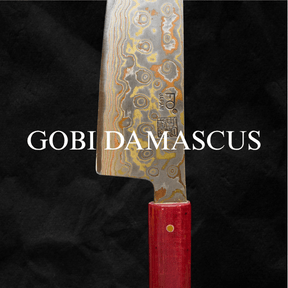
Gobi Damascus
The Tsukasa Hinoura Gobi Damascus range is a luxury collection created in collaboration with Japanese design house FAN OUT. The name “Gobi” can be translated as “overwhelming beauty”, which reflects the focus on combining high-level knife making with a striking, jewellery-like design.
The blades feature a unique Damascus pattern made from three different metals: copper, brass and stainless steel. These materials are hand-forged together to create contrasting gold, rose and silver tones across the blade.
At the centre of the blade is Aogami (Blue Paper Steel), also known as V-Toku 2 carbon steel. This high-carbon steel is known for its ability to take an extremely sharp edge and provides the cutting performance expected from a traditional Japanese carbon steel knife.
The blades are carefully ground and hand-sharpened by Tsukasa Hinoura, with close attention paid to the fit and finish of the different layers. The knives are finished with laminated wood handles injected with resin. The resin helps protect the handle from moisture while providing a durable and comfortable grip.
Due to the time-consuming traditional techniques used by Master Hinoura, production of the Gobi Damascus range is very limited and can be hard to secure. Their rarity, craftsmanship and unique Damascus designs make them highly sought after by chefs, collectors and Japanese knife enthusiasts around the world.
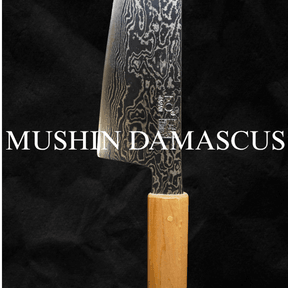
Mushin Damascus
The Mushin Damascus range is also created in collaboration with Japanese design house FAN OUT. The name “Mushin” means “no mind” or “empty mind”, referring to a state of calm and focus. Unlike the colourful Gobi range, Mushin has a darker and more understated design with deep, monochrome Damascus patterns.
The blades feature high-quality ATS stainless steel Damascus cladding, creating a distinctive dark wave pattern across the blade. At the centre of the blade is Aogami (Blue Paper Steel), also known as V-Toku 2 carbon steel. This high-carbon steel is known for its ability to take an extremely sharp edge and provides the smooth cutting performance.
The knives are also finished with laminated wood handles injected with resin. The resin helps protect the handle from moisture while providing a durable and comfortable grip.